




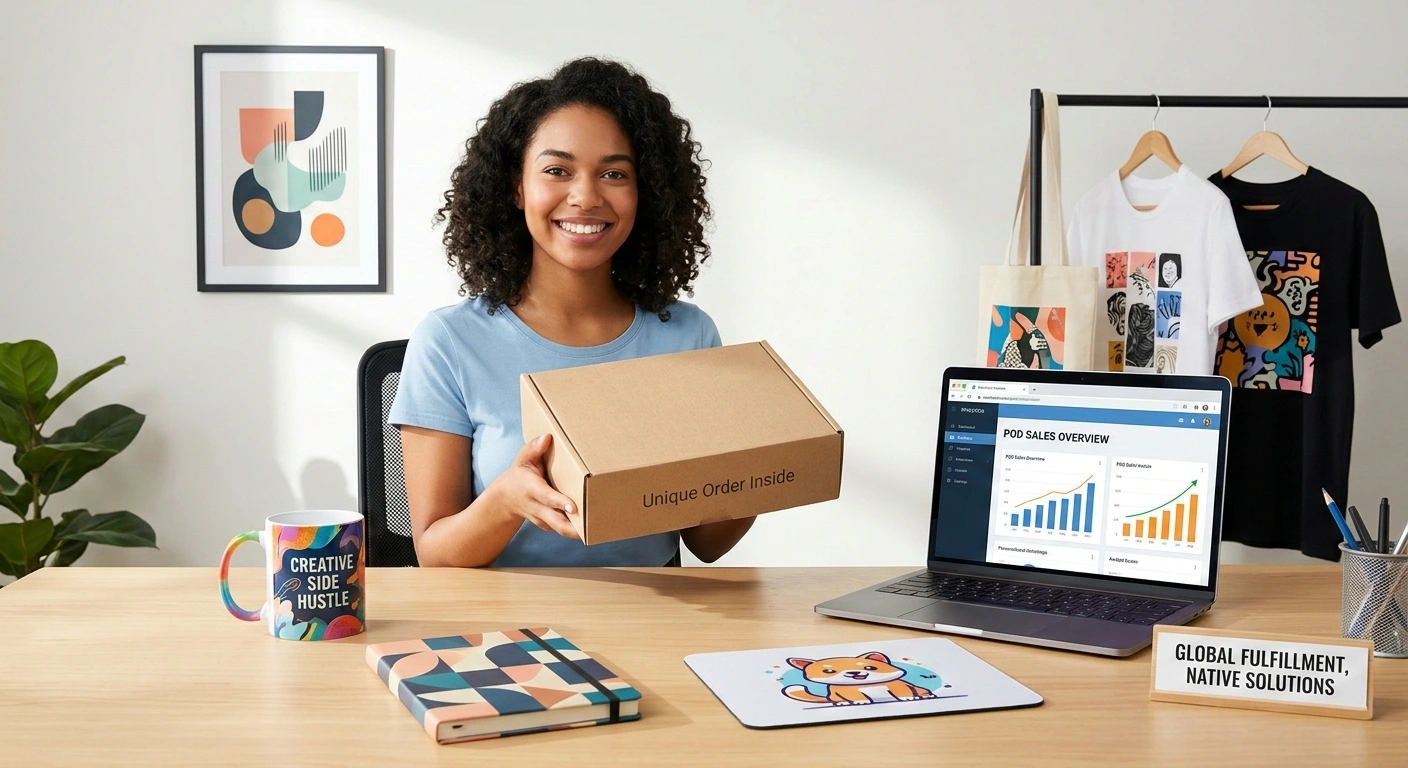
The biggest question we get in our inbox is: "Why should I start with POD for a cross-border side hustle?" And right after that, "Can I really make six figures a year with it?"
Let's clear the air and break down exactly what POD is.
Print-on-demand (POD) is more than just printing T-shirts. In simple terms, it's a "sell first, produce later" customization business.
For example, imagine a customer wants to create a personalized romper for their newborn with the birth date. You don't need to stock any inventory. You simply upload your design. When an order is placed, your connected fulfillment partner automatically prints, packs, and ships it directly to the customer. You never handle the physical goods—you make your money on the design value and the markup.
Today, everything from custom desk mats and notebooks to personalized wall art can be done via POD, making the product possibilities infinitely more diverse than just a few years ago.
The landscape has evolved. The advanced play for POD today involves a lightweight process that seamlessly integrates global manufacturing, local resources, and local fulfillment.
Which Platforms Suit Your POD Business?
- For Niche, Artisanal Markets: Perfect for targeting small, passionate communities. Imagine success with a "programmer-specific mousepad" featuring witty coding humor, selling hundreds of units a month at a premium price. However, platforms are starting to police "homogeneous design," limiting visibility if your patterns are too similar to others.
- On High-Volume Marketplaces: The traffic is immense, but the competition is deep. To win here, you need to target niches with high demand and low competition, like generalized hobby-themed apparel. Utilizing enhanced product pages with video (like showcasing your design process) can significantly boost conversion rates.
- For Discount-Driven Markets: The advantage lies in a massive user base and high exposure. Semi-managed models offer flexibility in pricing and avoid inventory pressure, backed by platform marketing support. However, fierce competition can compress margins, the platform’s focus is on low prices, and sellers have limited control. Product quality and shipping issues can also affect reputation.
- For Diverse Global Marketplaces: These provide access to a massive international audience, with flexible selling methods (fixed price or auction) and low entry barriers for testing products. But they face similar challenges: branding is difficult, competition is high, and buyers demand fast shipping.
- For Content-Driven Commerce: The strengths are a huge audience and the use of short videos to highlight product unique points, boosting engagement and immediate sales through integrated shopping. Challenges include reaching specific niche markets, transaction fees, and rapid trend changes leading to short product lifecycles.
- For Passive Income Seekers: Upload your designs, and the platform automatically generates mockups across various products (T-shirts, stickers, posters, etc.). When someone buys, you get a small commission without managing production or shipping. This is great for beginners but offers lower margins.
Current Mainstream POD Supply Chain Partners
Each partner has its strengths and weaknesses, so choose one based on your specific needs:
- For Simplicity: A popular choice for beginners who want a streamlined process. It features a straightforward editor to automatically apply your designs to mockups like mugs and backpacks. However, costs can be higher, making it a good idea to consider volume-discount plans once your sales stabilize.
- For Maximized Cost Efficiency: Solutions that work with hundreds of local facilities worldwide. If a customer in a key market orders, the system automatically matches a local factory for fast fulfillment—often within days—compared to shipping internationally. Pricing is typically transparent, making it easier to manage your margins.
- For Social Media Integration: A strong choice if you're skilled at short-form video marketing, seamlessly connecting your products for in-feed shopping on social platforms. This model supports efficient dropshipping with no minimum order requirements.
- For Vast Product Variety: A deep integration provider that offers a high degree of product customization, intelligent logistics, and attractive base costs, allowing you to manage orders efficiently with no inventory risk.
- For a Global and Localized Footprint: A leading solution featuring self-owned and partner production facilities across multiple continents (including Europe, the Americas, Asia, and more), offering thousands of diverse POD products for single-unit customization and dropshipping.
Three Critical Newcomer Pitfalls to Avoid
01 Trying to Do Too Much, Too Soon: Some people launch with 100 products, failing to optimize any. It's better to refine just 10 high-potential products, testing different keyword variations for each.
02 Neglecting Logistics Timeliness: Customers, especially in major markets, care deeply about speed. Prioritize partners with localized production capabilities to ensure faster shipping and avoid negative feedback.
03 Over-relying on Generic Design: While generic, quickly generated designs are fast, they lack uniqueness. Investing a bit more effort into a refined, unique design can increase your perceived value and profit margin significantly.
Ultimately, success in POD isn't about choosing the "perfect" platform, but about mastering the triad of People, Product, and Placement. Know who will buy, understand what will resonate, and find where they will see your content to drive interest.